feet, as is often seen in soldiers returning from war with mutilated arms and amputated limbs.
If a monster is natural and emerges from a human womb, it is important to distinguish it from discharges and "moles," which also proceed from the womb. According to Aristotle—an opinion supported in many places by Galen—a mole is a mass of flesh conceived within a woman's uterus. Both of these celebrated men drew this view from Hippocrates, who, in his books *On the Diseases of Women* and *On Sterility*, calls the mole a wicked and faulty conception and confirms it to be flesh. Later, Aetius and Paul of Aegina took up the subject, stating that a mole is unformed flesh residing within the membranes of the womb, which exits the body much like a normal birth. It is called a "mole" (*mola*) because, like a millstone (*molaris*), it is moved only with great difficulty; physicians classify it as a disease. It is described as "unformed," not because it lacks any shape whatsoever—for a mole can have various shapes, though most are round—but because it lacks a human figure.
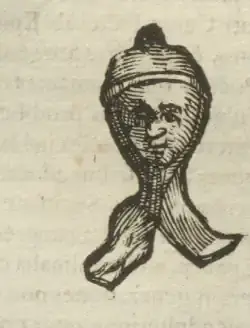
The distinguished physician Levinus Lemnius relates that he knew a certain woman who, after carrying a mass for nine months, gave birth to a round, unformed lump that had two handles attached to either side. Thus, it is called an "unformed" mole because it is alien to the human form. Nevertheless, in the Museum of the Illustrious Senate of Bologna, we find an illustration of a mole with the basic rudiments of human features, labeled *Mola anthropomorphos* (a human-shaped mole), which I am pleased to provide here for the reader's benefit. This specimen is perhaps not unlike the birth attributed to a certain woman of Augsburg, who, in the year 1531, gave birth to a human head wrapped in many membranes.
*A human-shaped mole.*
It should be noted, according to some authors, that while some moles lack all sensation and movement, others possess feeling and motion for a few hours. Some are entirely shapeless, while others acquire a certain form, like the "handled" mole mentioned by Levinus Lemnius, which exited the womb with a noticeable palpitation. These latter examples should be classified as monsters rather than moles. If anyone seeks the cause of these things, they should consult Hippocrates, who taught in his work *On the Diseases of Women* that a heavy menstrual flow receiving diseased seed should be cited among the causes of these ailments. Furthermore, we have the assertion of Averroes in his *Commentary on Aristotle*, where he argues that the primary cause of moles is a lack of harmony between the male and female seeds in terms of both quality and quantity.
Beyond discharges, moles, and abortions, a fetus that emerges from the womb at the appointed time but is unlike its parents is considered a natural monster. This may be either simple or double-bodied, and both