History of Monsters. 87
for which reason Galen taught that the parts of the foot correspond proportionally to the parts of the hand, since the toes are similar to the fingers in their shape, number, and arrangement. Because of this, we consider the number of bones to be twenty-six. As for why the big toe has only two bones while the thumb of the hand possesses three, Galen’s reasoning is that the lower bone of the thumb is separate from the metacarpus, whereas the big toe is joined to it. Furthermore, the big toe was made larger than the thumb because it must assist in the flexing of the feet.
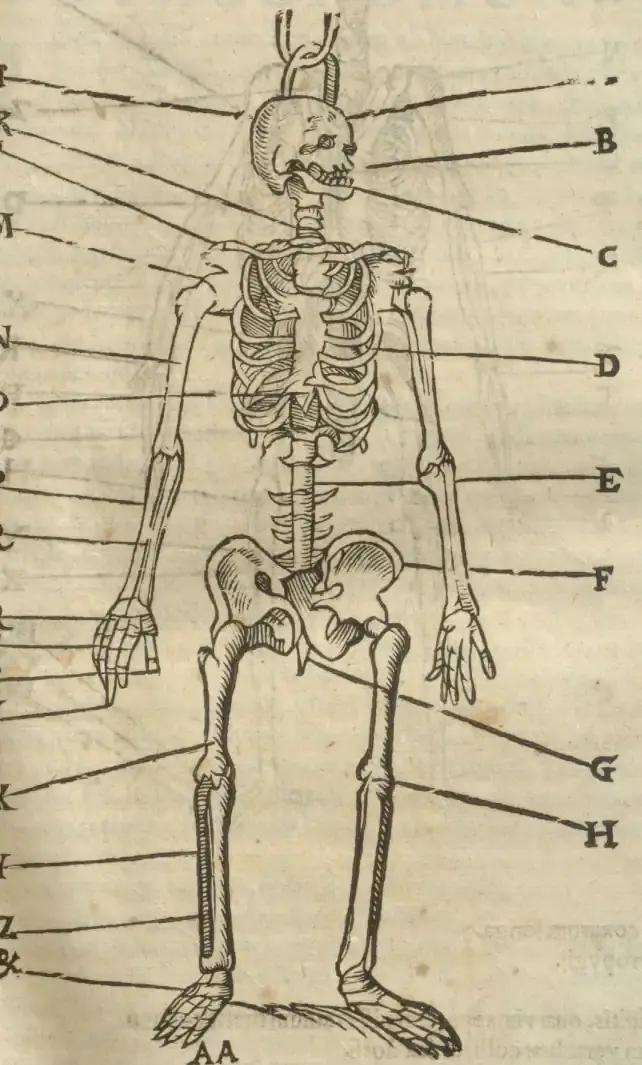
To provide a better understanding of these bones, I have seen fit to place the illustration of a human skeleton alongside that of a bird, so that the reader may contemplate the great similarities between them, as we have found these images in our Museum.
Human Skeleton.
The explanation for this illustration, which brings together human bones in comparison with a bird’s skeleton, is as follows:
A, B. The beak, which serves the function of both teeth and lips.
M. The bones that the French call *pallerons* [shoulder blades], which are long and narrow, with one on each side.
\*. The bone called the *furcula* [wishbone], which is found in no animal other than a bird.
D. Six ribs attached to the thorax in the front and to six vertebrae in the back.