144 Supplement to the History
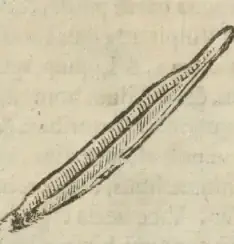
The bony genitalia of the fox.
# ON MONKEYS
[[ASSET:initial01]] The hunters of the East show great ingenuity, using a remarkable technique to produce stones from monkeys, which they later sell as bezoars. At a certain time of year, they set out to hunt monkeys, not to kill them, but merely to wound them lightly with arrows; once the animals are bloodied, the hunters do not pursue them further. In the meantime, a kind of stone forms within the monkeys' bodies from the blood. Indeed, each animal produces as many stones as the wounds it sustained from the arrows. When the hunters judge that these little stones have matured, they go out again to capture the animals, this time killing the monkeys to retrieve them.
Some classify the animal that the Indians call the *Mapach* [raccoon] as a type of monkey or long-tailed ape, though others categorize it among the local small foxes. It is given various names by the Indians: some call it *Illamaton*, or "Little Old Woman"; others *Maxtle*, or "Cotton Belt"; and still others *Cioatlamacazqui*, or "Priestess."
It is an animal slightly larger than a Maltese dog, low-slung and well-rounded, covered in fur of mixed black and white colors. It has a large head, small ears, and a snout like a hunting dog's, with distinct white bands running straight past its eyes. It has a long tail and hands and feet that are almost human, which it seems to use to feel everything. Once tamed and raised in the home, it becomes quite gentle and eats whatever is offered. It lies near its masters, rolls on the ground, and frolics and plays in a thousand ways, imitating a small fox in its cleverness and behavior. Like a cat, it washes its face with its hands, and like a monkey, it uses them to bring food to its mouth. While it acts like a fierce beast toward strangers and newcomers, it is affectionate toward those it knows.