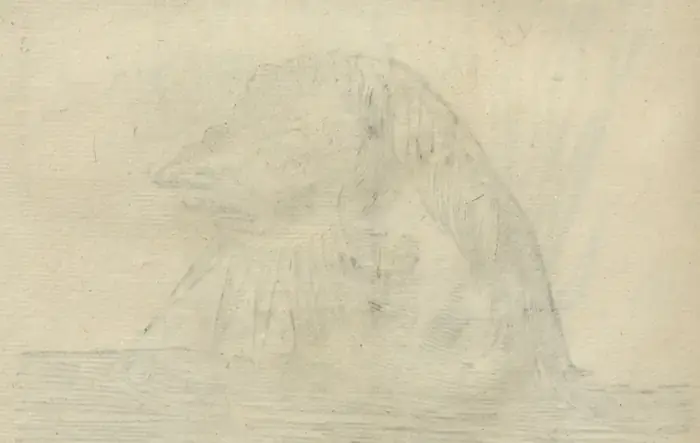
next, in that same passage, Olaus Magnus depicts another massive animal, terrifying with an almost fiery appearance, a square head, a long beard, and marked by many horns. Gessner chose to call it the "Bearded Whale." Its head is rayed with fourteen horns which, beginning from either side of the eye, extend across the back of the head. Gessner, however, doubts whether this animal has been described accurately. Indeed, Albertus Magnus wrote that some whales do not have horns, but rather certain bony appendages around the eyes, about eight feet long—give or take, depending on the size of the fish—which taper from a wide base to a sharp point.
Among the whales is also classified the Physeter, or Physalus. Although in Aristotle's works the word *physeter* refers to the blowhole through which these creatures eject water, Gessner notes that some call the animal itself a Physeter because it stirs up whirlpools and churns the waves of the sea. Although it is a creature of immense bulk, it never reaches the size of a True Whale. William Turner wrote to Gessner that such a beast sometimes pours so much water from its blowholes onto ships that they are easily capsized and sunk.
In maps of the northern regions, they depict the Physeter with a horse-like body, a head without ears, wide nostrils, a mouth without a tongue, and two prominent blowholes, as may be seen in the following illustration. However, we agree with Gessner that this depiction is absurd; the reader will find a genuine likeness of the Physeter illustrated in our *History of Fishes*, specifically in the section on whales