History of All Animals. 87
others are larger and yellow. Likewise, Gesner writes that he had heard of a yellow trout being caught somewhere in Germany.
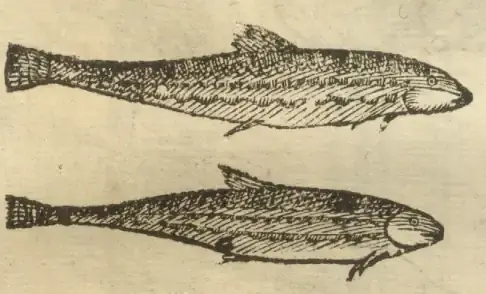
In any case, we wish for the present to display an illustration of the common trout, which some maintain is a species of eelpout and believe to be the same as the *Spinulus* described by Albertus Magnus. It may also be called the red *Spinula*, such as those caught near Bologna in the Savena River.
*Common trout, or red *Spinula*, caught in the Savena River.*
ON THE PIKE
The Pike is a fish known to everyone, so named because it is said to shine at night. While this is a marvel, the fish is most remarkable for its head. The author of *On the Nature of Things* writes that the Pike carries a stone in its brain that resembles crystal. We, for our part, marvel at the animal's head because it possesses a long snout and an enormous maw, which Rondelet compared to the beak of a goose.
The lower jaw is longer than the upper and is hollowed out like a spoon. It contains numerous teeth arranged in various ways and, according to Albertus, of varying sharpness. In the front part of the lower jaw, the teeth are small and curve back toward the throat; in the upper jaw, there are no teeth at all. This is because the upper jaw is wider, and any teeth projecting from it would not meet the lower ones, rendering them useless. Therefore, in their place, nature—as Rondelet observes—has fixed two rows of teeth into the palate.
We have chosen to explain all these features with an illustration of this animal's head, as it was not included in our *History of Fishes*. Furthermore, we have added the remaining internal parts of the Pike, carefully drawn and examined by the most illustrious Giovanni Antonio Godi, the most celebrated anatomist of our age, as the reader will be able to see in the following illustrations.