ON THE SMELT
Rondelet calls a certain fish *Eperlanus*—an illustration of which is provided in the *History of Fishes*—because its luster resembles a "union," that is, a pearl.
Belon and Gessner, however, call it *Epelanus*. Gessner describes the *Epelanus* of the Seine, which is common in Paris, suggesting the name may be derived from *Excellanus* due to the excellence with which it surpasses other fish of its kind. He considers it very similar to the bleak, differing only in that it has reddish bases at its fins and a lateral line that curves sharply toward the tail; it typically reaches a length of five fingers and a width of one thumb. He further writes that it is called *Borbolus* by the people of Ferrara, and *Ouella* by those in Rouen, because this fish is always found pregnant with eggs.
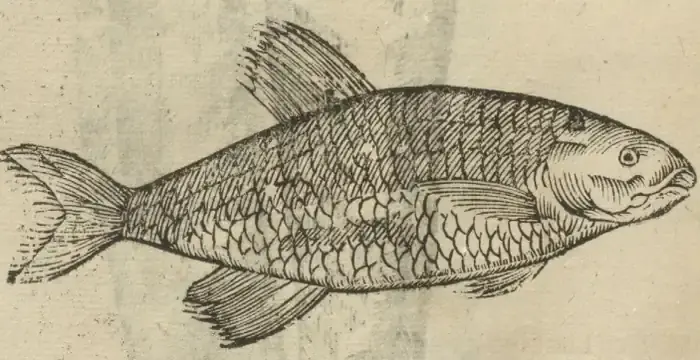
Its form is shown in the following illustration.
Gessner’s Smelt.
ON TROUT
The trout (*Truta*), so named from "pushing" (*trudendo*) against the rush of the water, encompasses many species. Some are found in rivers, while others live in lakes and are known as salmon-trout. Furthermore, among the river trout, some are large and others small, and they also vary in color. Rondelet reports that some trout are small and white, such as those found in the rivers of the Santones and the Boii, while others