31 · A History of All Animals
# On the Varieties of Multipedal Creatures
The ancients identified three distinct types of terrestrial multipedal insects: the *Iulus* (millipede), the *Scolopendra* (centipede), and the *Oniscus* (woodlouse); it is the last of these that we shall discuss here. Aristotle referred to woodlice as *onos polypodas*, or "multipedal little donkeys." This was not without reason, as the Greeks applied the name "little donkey" (*asellus*) to many kinds of creatures. He added the qualifier "multipedal" because the ancient Romans also designated these beasts as "multipedes" based on the number of their feet. Galen called them *oniskous*, noting that among his own people they were known as *kyamous*—that is, "beans." He described them as animals that curl themselves into a ball, earning the name "beans" because they resemble edible beans when spotted under water jars. Indeed, Galen mentions these "little donkeys" frequently, writing that they are born and live in the dampness beneath such vessels.
Marcellus Virgilius, in his commentaries on Dioscorides, similarly called these small creatures *onoi* (donkeys), just as Galen called them *oniskous* (little donkeys), because they are endowed with a leaden-gray color like that of an ass. One might also consider their gait; for although they are equipped with many feet, they move with a slow, heavy pace, much like a donkey. The Italians call them *porcelletos* ("little pigs") due to the appearance of their entire body, and the Latins likewise call them *porcelliones*.
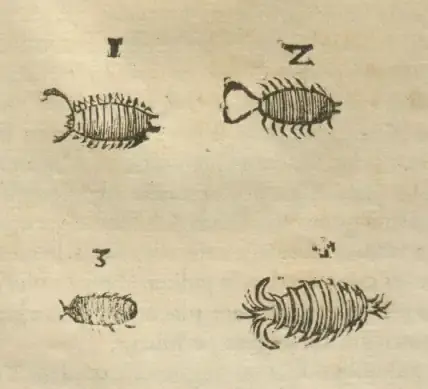
There are, however, various species of these creatures that were neither mentioned nor illustrated in our previous *History of Insects*. For this reason, the reader may examine them here. We observe the ash-colored woodlouse, followed by another of a dark ash-gray. There is also a species with white spots mottling the middle of its back, and finally, an exotic woodlouse, perhaps of the sort described by Ambroise Paré in his writings on various animals excreted through urine.
1. Ash-colored woodlouse. 2. Another dark ash-colored woodlouse. 3. Another with white spots mottling its back. 4. Exotic woodlouse.