30 Supplement to the History
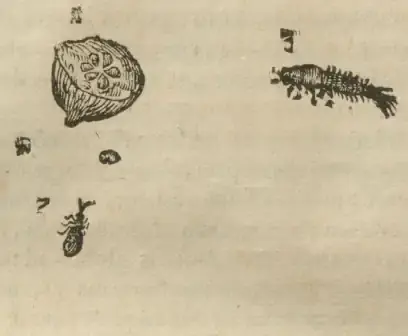
a fly emerging from an oak gall, and a cockroach that cuts through cloth.
On Spiders
Many species of spiders are found in the New World, the most notable of which I have decided to record here, as many others have already been described in my *History of Insects*. One species, which exceeds a pigeon’s egg in size, is called the *Ahoachrocatl*; despite its great bulk, it is said to be entirely non-venomous. On the other hand, there are other spiders among the Caribs that are as large as half a citron. Though their legs are small, they are equipped with long, sharp teeth and weave a web strong enough to ensnare any small bird that happens to fly into it. This silk could even serve as a *calantica*—a woman’s hairnet or head-covering—particularly because it turns white when washed.
Another species is known as the *Hoitztocatl*, or "thorny spider," whose bite causes a loss of reason. Its upper and middle sections are black, while the rest is yellow; its prickly shape resembles a caltrop, which earned it its name among the Indians, for *hoitztli* means "thorn."
The *Atocatl* is a spider that lives near water, variegated with red, gold, and black. It makes its home on the plant the locals call *metl* and weaves its web with such marvelous dexterity that it is always perfectly circular, as if drawn with a compass. Its bite is harmless, or at least very mild.
Finally, in those same regions, there are tiny spiders distinguished by gold and black spots. Their bite is quite dangerous, as it drives the victim into a kind of frenzy and causes numbness in the limbs, accompanied by great anxiety and pain. The Indians combat these symptoms with their own specific antidotes.