The History of Monsters. 347
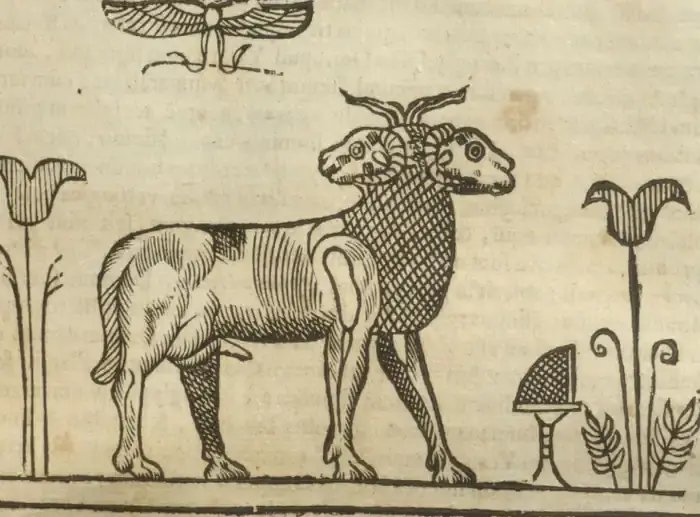
Two-headed ram
HIEROGLYPHS
Tacitus once recorded in his chronicles that the ancient Egyptians represented the thoughts of the mind through the figures of animals. However, it would have been more accurate to say that they expressed the soul's intentions through monstrous figures, since only monstrous images of living creatures are seen on the Bembine Tablet (which we mentioned in the previous section).
Furthermore, we observe in the work of Valeriano—beginning with the head—a two-headed figure lacking arms and feet. He established this as a hieroglyph for the firmness and stability of those who are well-advised, for things done with mature counsel usually achieve stability. The image was depicted without hands or feet to express divine power, which has no need for such members to carry out its work.
Next, a three-headed figure was seen among the ancients, consisting of the heads of a lion, a dog, and a wolf. The lion's head indicated the present time, because its nature is "fervent" between the past and the future. The head of the wolf—a forgetful animal—designated the past. Finally, the image of a dog's head was understood to represent the future, as this animal, by fawning on humans, suggests hope, which always seems to belong to the time to come.
Another three-headed figure can be seen in Valeriano, which he asserts signifies Spain divided into three parts. However, the commentator on Hesiod suggests this is a hieroglyph for the Moon, whose dominion the ancients believed extended over the Heavens, the Earth, and the subterranean realms. We can confirm this further, as Pierio elsewhere assigned this monstrous three-headed figure—integrated from human, canine, and equine faces—to Diana, who was held by the ancients to be the same as the Moon. In support of this, we might add that the Egyptians attributed the same power to the three-headed god Anubis as the Greeks proclaimed was held by Hecate (otherwise known as Diana or the Moon).