# 16 Ulisse Aldrovandi
Finally, hair and skin provide us with the last point of distinction in our survey. John Mandeville describes a certain island whose inhabitants are covered in thick hair, except for their palms and faces; likewise, Pigafetta depicted the people of the island of Butuan as hairy, fierce cannibals. Furthermore, setting aside the wild men mentioned by Pliny and Solinus, we shall now consider those recorded by Peter Martyr. He left a record for posterity stating that wild men dwell in the province of Guacaiarina, living in crude, low-lying caves. They subsist on wild fruits and never have any social interaction with the other inhabitants of the island; indeed, even when captured and treated kindly, they could never be tamed. For this reason, they are believed to recognize neither government nor laws. Similarly, on the island of Ireland, which is subject to the King of England, there are almost countless wild men who have never wished to have any dealings with those living by the sea. A certain Sarmatian once brought a piece of a wild man's skin to the excellent Ulisse Aldrovandi, which is still preserved today in the Museum of the Illustrious Senate of Bologna. He reported that this skin is worn in a ring to treat convulsions, to the great benefit of the sufferer.
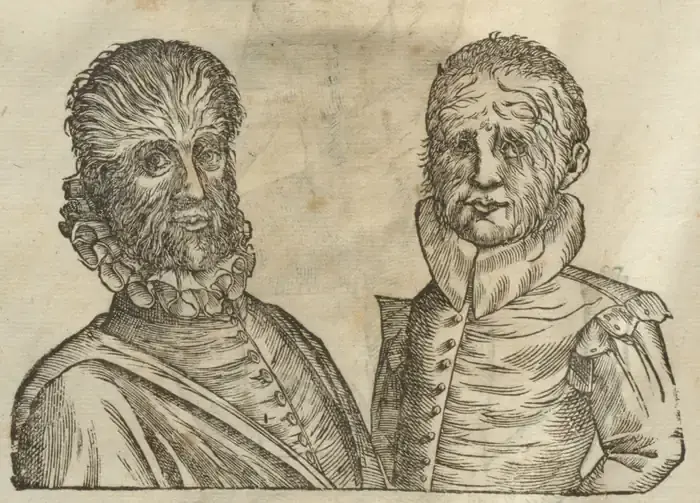
This wild race of humans was first seen in Bologna when the most illustrious Marchioness of Sorano, while visiting the city, was most honorably received by the distinguished Mario Casalio. She brought with her a hairy eight-year-old girl, the daughter of a wild man (aged forty and born in the Canary Islands) who fathered not only this daughter, but also another girl of twelve and a son of twenty. Portraits of all of them are presented here.
A father aged forty, and a son aged twenty, hairy over their entire bodies.