110 Ulisse Aldrovandi
Furthermore, the people of America, whom André Thévet calls "wild men," go about naked. This is not because they lack materials from which clothing could easily be prepared, nor because they are oppressed by the excessive heat of the region, but because they report that they can exercise more easily and effectively while naked. For this reason, if someone wearing a cotton tunic—which they do occasionally enjoy—spots an enemy from afar, they quickly strip it off to prepare for battle. Indeed, as Thévet notes, they claim that clothes hinder them from overcoming their enemies; in fact, they help their foes grab hold of them more easily.
For this reason, we provide an image of a wild man covered in a feathered headpiece; equipped in this manner and armed with a club, they go forth to war. Truly, the most beautiful species of birds roam the American regions, which the inhabitants prize highly. They pluck their feathers three or four times every year to fashion tapestries and, especially, headpieces, hats, and many other works. These birds are very similar to parrots in their feet, head, and beak, and are so tame that they spend all their time around the Americans' huts. Even though they go to the woods to sleep in the evening, they nevertheless return to the wild men's dwellings at dawn.
Thévet later mocks those who have claimed such wild men are hairy; in reality, they are not only smooth-skinned but even pluck out any hair that begins to grow with their fingernails—though today, according to the same Thévet, they use certain tweezers.
These peoples also differ among themselves in their level of boldness. Those who live along the seacoasts are more warlike, for they strive greatly to resist not only their enemies but also anyone else sailing nearby. Their King is called Quonianibec in the local tongue. He is eight feet tall and proportionally broad, a man whom Thévet records having seen in his histories. His subjects also emulate this giant stature, live on human flesh in the manner of Cannibals, and can overtake any wild beast in a race. An image of this King has been provided.
However, since the map of America contains an image of Tarizich, King of the Cannibals (who are also man-eaters), we decided to present his image here as well, so that the reader might reflect on the similarities between these two figures.
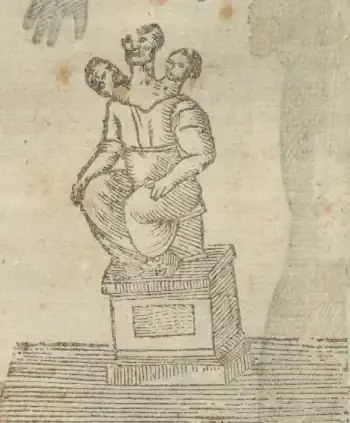
Finally, bringing this section to a close, we add a three-headed idol that is worshipped as a god in Lapland. Indeed, the inhabitants of that region are said not to be entirely ignorant of the immortality of the soul. On the map of Asia, this figure is depicted in this manner. Let these remarks on the customs of nations suffice. Whoever desires to read more and more detailed accounts should consult those authors who have written not only about customs but also about the various garments of nations. Or rather, let them sing this couplet with the Poet:
"I cannot hope to count such a vast number of customs, For every passing day adds new fashions to the world."