History of All Animals. 147 # ON PORCUPINES
In Malacca, there lives a certain species of porcupine in whose gallbladder a stone is formed. This is called the Malaccan stone, and it is preferred over every kind of bezoar. Indeed, it is held in such high esteem among the natives that Garcia da Orta wrote that of the two found in his time, one was sent as a supreme gift to the man governing India on behalf of the King of Portugal. Although bezoar stones are frequently found in that region, the inhabitants nevertheless prefer this porcupine stone to all other antidotes. Garcia reports that he saw only one; its color appeared to be a pale purple, it had a bitter taste, and it was slippery to the touch like French soap. Clusius adds that in the year 1603, he saw a similar small stone, perhaps flat and no larger than a human fingernail, light in weight, and of a grayish-white color, though sprinkled with small rusty spots. It was highly recommended against poisons. They said it had recently been brought from the East Indies and called it a "hog stone." From these characteristics, Clusius conjectured that it might be the aforementioned Malaccan stone that is occasionally found in the gallbladder of a porcupine.
Ferdinand Lopez also mentions a certain stone to which he attributes no less power than the bezoar or Malaccan stone, as it resists all poisons in a marvelous way. This stone is the size of a hazelnut and is extremely rare, as it is said to grow in the head of an animal that the Indians call the *Bulgoldalf*.
Other matters pertaining to our local porcupine were recorded in the *History of Digitated Animals*, where one can see not only an illustration of the porcupine but also its hide. In that work, the external skin of the porcupine's back, tail, and rump are displayed, as well as the internal skin and the front and back feet. Now, we include drawings of other parts of this animal, as shown in the illustration.
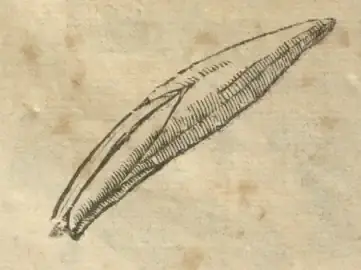
Furthermore, we also provide here a drawing of a tooth from this animal, or one very similar to its front teeth, which was shared with us some time ago. This tooth had membranes attached along its sides; it was slender at the point of attachment, and a groove was visible down the middle, though it was not as deep as is usually seen in the teeth of a porcupine. Indeed, the tooth of this animal typically mimics the shape of two teeth joined together. Consequently, we do not state with certainty that it is a porcupine tooth, unless perhaps Nature has produced a monstrous tooth, as occasionally happens among animals.
Tooth similar to the front tooth of a porcupine.