Supplement to the History of All Animals. 141
ON WOLVES
In the warmer regions of New Spain, it is said there is a wolf known to the Indians as the *Cuetlachtli*. It resembles the wolves of our own lands but has a significantly larger head; it is known to attack bulls and, on occasion, even humans. Some individuals of this species are found to be entirely white.
The wolves in the region of Bamba are exceedingly fond of palm oil. This oil, expressed from the fruit of palm trees, is thick and as pliable as butter; it is collected in gourd shells and stored with great care. It is truly remarkable, however, how skillfully these wolves steal it. They grip the vessels firmly in their teeth and hoist them onto their shoulders—just as our local wolves do when they have snatched a sheep—so that they may run more nimbly and escape the blows of those who pursue them.
ON THE HIPPOPOTAMUS
In my *History of Multi-toed Quadrupeds*, I made mention of the hippopotamus, as its hooves are indeed divided into four toe-like segments. In that volume, I provided illustrations of both the male and female hippopotamus, as well as a figure of the head to better display the teeth. I now present to the reader a depiction of the front part of a female hippopotamus, in which the wide, flared nostrils can be more clearly observed.
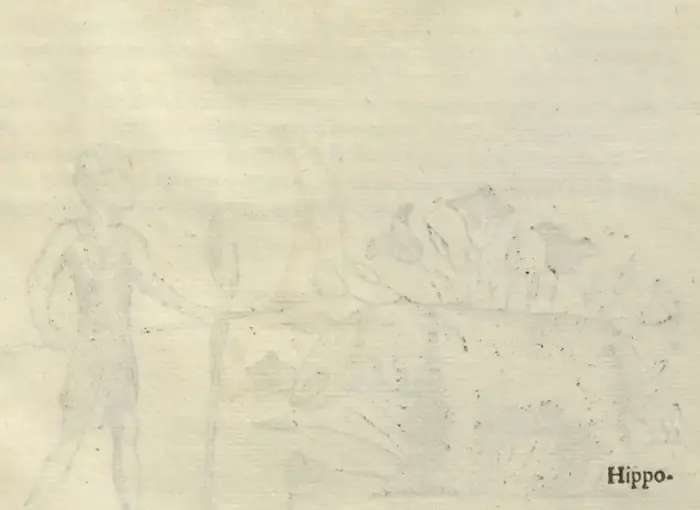
Furthermore, I do not wish to pass over in silence the depiction of a certain beast related or similar to the hippopotamus, which was drawn among the hieroglyphs on the Bembine Tablet. There, this animal is shown as a multi-toed and very stout creature, appearing as if it were in a field, with a tail that is likewise thick and short. In front of this animal, an Egyptian man can be seen, who appears to be attacking the beast with a weapon, just as can be observed in the illustration provided.