126 Supplement to the History
ON DEER
In New Spain, one does not find just a single type of deer. Some are red, while others are entirely white. The Indians call these "Kings of the Deer" or *Yztacmacame*. Others are similar to our own in form, size, and temperament; these they call *Aculhuame*. Smaller than these are the *Quauhtlamacame*, which are remarkably bold and lack the usual skittishness of deer. When wounded, they become ferocious, attacking and often killing hunters. The *Tlalhuicamacame* are of similar size and habit, though they possess less courage. Finally, the smallest are referred to as *Tamamacame*.
In Duarte Xapida and other regions of the New World, herds of deer roam just as cattle do in our lands. They give birth at home but are allowed to wander through the forests to graze during the day. In the evening, they return to the house to see their young, which are kept back. Indeed, once their fawns have fed, they allow themselves to be milked, for cheese is made from no other milk there. In the North, people hitch deer to carriages, which they use to travel at great speed.
In some regions of the West, deer struck by hunters seek out the herb *Atochielt* (as the natives call it; it is a type of pennyroyal). They are restored by this plant, recovering their strength and gaining a new swiftness; for this herb is more readily available to them than the virtues of dittany.
In Virginia, the deer are endowed with longer tails than our own, and the tips of their antlers curve back toward their spines. There is another kind of deer in America that is shorter than our own, with smaller antlers and long, goat-like hair. In the regions of New Mexico, deer wander with very long and hairy tails like those of mules, which they exceed in size and are said to be of the greatest strength. Furthermore, let us include an illustration of that animal which combines the form of a deer and a horse, known as the *Hippelaphus* or "Horse-deer." Indeed, we also offer an image of the creature that resembles both a deer and a camel, which Mattioli calls the *Elaphocamelus* in his letters.
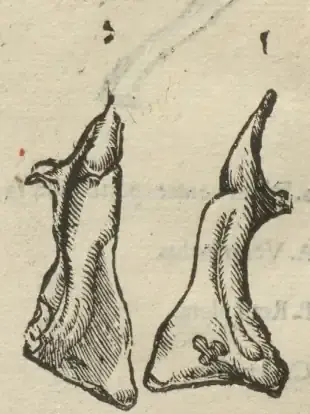
I have decided to present here a true depiction of the bone from the heart of a deer, shown from both sides as seen in figures 7 and 8. For there can be no doubt that in the sub