Supplements to the History. 114
# SUPPLEMENTS TO THE HISTORY of all Quadrupeds.
CONCERNING THE UNICORN.
Regarding the form of this animal, authors differ in their opinions, as was recounted in the *History of Solid-Hoofed Animals*. Since some assign this beast to the category of solid-hoofed quadrupeds, others to the cloven-hoofed, and still others to the clawed species, it is perhaps no wonder, for it is said that even horned dogs live in certain places.
Nevertheless, it is most often numbered among the solid-hoofed quadrupeds. Indeed, they testify that in the West Indies, the inhabitants of Vera Paz claim that a large horse-shaped animal, bearing a thick horn on its forehead, lives among them. Other authors, however, report different things; nonetheless, it is still not entirely clear what the form, nature, and status is of that animal which is preeminently called the "Unicorn." To be sure, traveling peddlers display horns and fragments of horns which they claim belong to the Monoceros, although they possess no certain evidence to prove it.
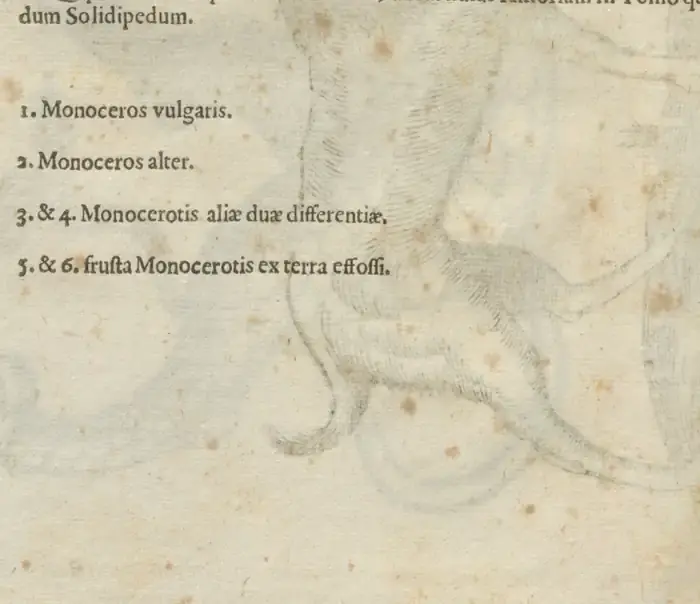
We, likewise, present here drawings of the many variations of this horn that have come into our hands. In the first place, the common Unicorn is depicted; then a second type; in the third and fourth places, two other varieties are proposed; and finally, two types of Unicorn horn dug out of the earth. For it sometimes happens that cetaceans—great sea creatures—are driven by the sea onto the sands and buried there; many years later, bones are unearthed from the deep bowels of the earth that resemble horns, and these peddlers convince gullible spectators that they are the horns of the Unicorn.
Anyone who desires to know more about this animal should consult its history in the volume on *Solid-Hoofed Quadrupeds*.
1. The common Unicorn. 2. Another Unicorn. 3. and 4. Two other varieties of the Unicorn. 5. and 6. Fragments of a Unicorn dug from the earth.
For which reason we present at this time an image of a rhinoceros horn, which is by some called the horn of a Monoceros. Likewise, an image of a cup made from the horn of the same rhinoceros, which is similarly considered to be a Unicorn horn. Wherefore