Of All Animals. 111
This fin must belong to an aquatic animal, as its shape closely resembles an oar. According to the opinions of philosophers, fins are said to be four in number for the purpose of navigation, though sometimes there are only two, as in the case of eels. Furthermore, such fins often differ from one another in substance, size, shape, color, number, and in their excess or deficiency. Some consist of a solid substance, others are composed of fibers and membranes, some of cartilage alone, and finally, others are seen to be made of both cartilage and bone, as can be observed in marine monsters.
Therefore, in our opinion, this fin must belong to some marine monster, since it shares a nature halfway between cartilage and bone, and its color rivals that of ivory. Additionally, some fins represent bird wings in their proportions. Similarly, this one—nine inches and two palms in length, and as wide as a pinky finger—is split into thin threads from its midpoint to its tip. It looks like the branches of a palm tree before the leaves have fully expanded; therefore, it is not unreasonable that this fin might be called *Phoenicites*.
As for which animal it belongs to, nothing certain can be put forward. It is possible that this is not an entire fin, but rather a part or fragment of a larger one. Likewise, it could be one of those found on the back, near the vent, or at the tip of the tail.
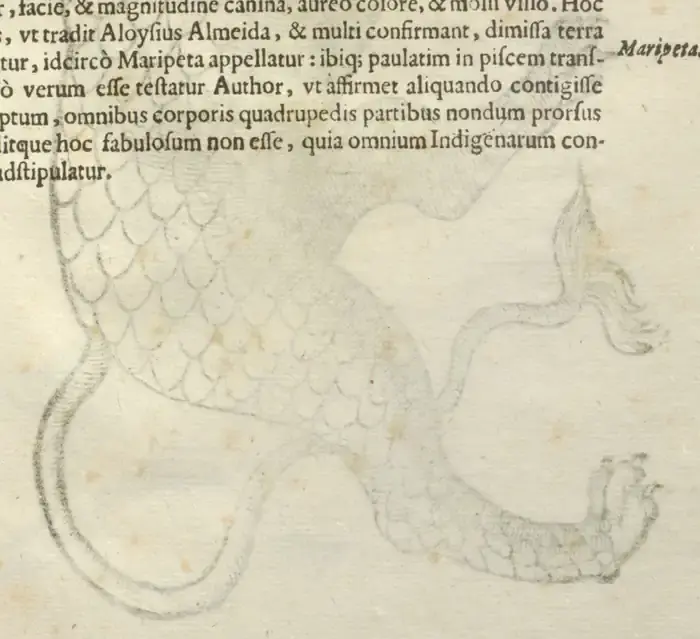
Before we move on to the supplements of the history of quadrupeds, we have decided to consider a four-legged fish, or whale, so that it may serve as an entry point for examining the family of terrestrial quadrupeds. This animal was captured in the middle of the Tyrrhenian Sea not long before the death of Pope Paul III, much to everyone's astonishment. It had the form and size of a lion, as depicted in the illustration, but with a scaly body and a voice somewhat resembling a human's. They say it was brought to Rome, where it did not live long, being deprived of its natural environment and proper food. Philippe Forest, as cited by Paré, recorded the history of this animal.
Consequently, this animal seems to be of the kind born in certain forests in Japan, which have the face and size of a dog, a golden color, and soft fur. This type of animal, as Luis de Almeida reports and many confirm, leaves the land of its own accord and enters the sea, which is why it is called the *Maripeta*, or "Sea-seeker." There, it gradually transforms into a fish. The author testifies to the truth of this so strongly that he claims fish have sometimes been caught whose quadrupedal body parts were not yet fully transformed. He adds that this is no fable, for the consensus of all the local inhabitants supports this truth.