70 Supplement to the History
# ON LAMIA SHARKS
The Lamia takes its name from the Greek *laimos*, referring to the throat, because of its immense gullet and voracious nature. However, according to Pierre Belon, this fish is unknown to our local fishermen. Although Nicander—and Guillaume Rondelet, relying on his words—did not distinguish the Lamia from Aristotle’s *Carcharias* shark, a careful study of Aristotle’s own writings reveals that the philosopher classified the Lamia among the flat fishes, rather than the dogfishes.
Furthermore, Oppian also distinguished Lamias from dogfishes. Therefore, following Belon, we must conclude that the Lamia is a broad, flat fish. According to the same author, this fish grows to a massive size and is covered in rough skin. Its mouth is located at the front of the head, much like a monkfish. It is truly remarkable, as he notes, that the mouth is packed with roughly two hundred teeth, arranged in four rows in each jaw; these are broad at the base, tapering into a pyramid, and serrated along the sides.
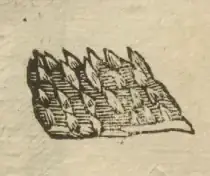
These remarks by Belon have given many scholars cause for doubt, especially since Belon omitted an illustration of the animal and seemed to confuse the beast with the *Carcharias* shark. Indeed, it is hard to believe that a flat fish would be armed with such large teeth. While we do not deny that it has many teeth, they are generally quite small, as can be seen in the following illustration.
Small teeth found in the mouth of a Lamia.
Furthermore, we provide here an illustration of a "cetacean Lamia" brought from the shores of Epidaurus, so that at least some image of this animal might be included in this vast History of Fishes.