History of All Animals. 59
ON THE ATHERINA
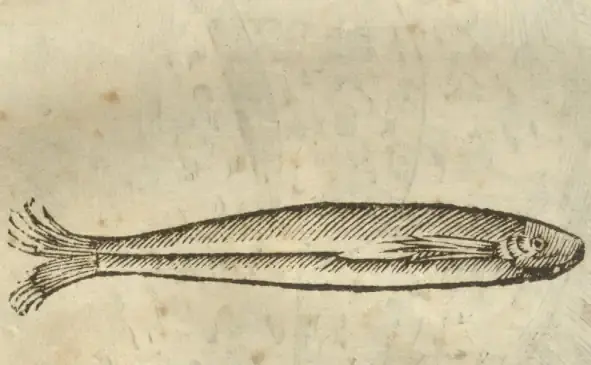
The Atherina is a small marine and coastal fish also found in saltwater lagoons. It resembles the *Aphyis* and reaches a length of about nine inches and the thickness of a little finger. It has a thick back, a slightly flattened belly, a small toothless mouth, and large eyes. Its coloring is varied: the belly is silvery, the back is dark, and it takes on a reddish-yellow hue around the head, much like a sardine. It possesses four fins—two near the gills and two on the belly—plus another by the vent, and two additional fins on its back; all of these are white. The tail consists of two fins, as appears in the illustration by Pierre Belon. In place of a lateral line stretching from the gills to the tail, a thick structure is visible beneath the skin, which can only be compared to a "band" or *fascia*. While two illustrations were placed in the *History of Fish*, a third is now added, which we found in the public museum, so that the reader may compare these images and select the most appropriate one.
Another Atherina.
ON THE TURBOTS
Two kinds of turbots are recorded in the *History of Fish*: one smooth and the other prickly. The prickly variety has many spines on its upper side, especially around the head and extending from the head toward the tail. The other kind lacks these spines entirely but is otherwise similar, except that it is thinner and has a larger, more elevated head, according to Belon.
Furthermore, both varieties differ in size; indeed, those caught in the open ocean are larger than the others. Since three illustrations of turbots were exhibited in the previously cited passage—namely, the prickly turbot, the smooth turbot, and the true smooth turbot—we now add an illustration of a species different from the aforementioned ones. It has the coloring of a shark with dark spots, and could be called "another smooth turbot." Additionally, another illustration of a prickly turbot is included, and these images are to be examined below.