Of All Animals. 51
...three fingers long. It has certain ridges and lines on its exterior, but none in the middle, as can be seen in figure 3. In figure 6, it is depicted near the lower part that was attached to the animal; there is a large cavity there, while on the upper part, it has a sort of shiny appendage that seems to mimic a fingernail.
Since some authors add mussels to the category of shellfish, I do not want to overlook a most beautiful species of mussel which the illustrious Clusius called the "shell-bearer," observed in the year 1599. This shell-bearing mussel was seven inches long and three inches wide at its broadest point, with a shape not very different from the "long shell" described by Rondelet. The shell was thick and wrinkled, appearing to have consisted of two gaping valves; it was hollow with a raised black back to which the tubes of small worms adhered. There were also small "shrubs" six or seven inches long—some thickish, others more slender and very branched—from which small shells hung, resembling hairy mussels as if covered in locks of hair.
ON TURBINATE SHELLS
Since the term "Turbo" is used for anything that has a pointed shape at the bottom and a wider one at the top, we cannot deny that this name applies to the shellfish we are currently discussing, as these turbinate shells possess this particular form.
Aristotle, then, placed a single shell simply called the "turbo" among the turbinate creatures, and then grouped all others under the same name without regard for size or quality. However, Rondelet and Ulisse Aldrovandi have recorded almost infinite varieties of these shells. They have observed some that are large, others small, some pointed and some blunt; some possess "ears," while others are covered in bumps; some are smooth and others rough, some angular, some prickly like a murex, some with four "fingers" and others with five, and finally, some of a single color and others multicolored.
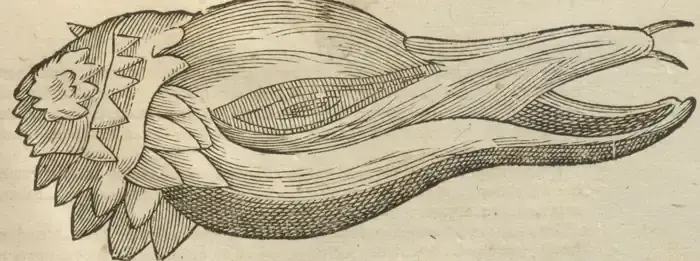
Among so many varieties illustrated with so many figures by these famous men, not one was depicted with its soft tissue. Therefore, for the sake of scholarly curiosity, we present here a pointed whelk together with its snail-like body.
*A pointed whelk with its snail.*
DE