History of All Animals 13
Furthermore, we have included illustrations of previously omitted varieties of chicken eggs that display a somewhat monstrous nature, as can be seen in this table: 1. A chicken egg as round as a ball. 2. Another small, round chicken egg with an extremely hard shell. 3. A chicken egg the size of a pigeon’s egg. 4. A monstrous chicken egg, notably wavy and wrinkled. 5. A monstrous chicken egg in the shape of a long-necked gourd. Additionally, the eggs depicted under numbers six and seven belong to other animals; number six represents the egg of a land tortoise, and number seven shows the likeness of an owl's egg, both of which were engraved on the same plate.
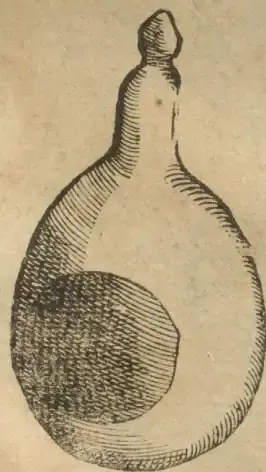
To the aforementioned, let us add an illustration of another, even more bizarre chicken egg, which features a neck like a flask.
*A chicken egg with a neck like a flask.*
Ulisse Aldrovandi later discussed the Capercaillie—both the greater and the lesser varieties—in more detail in the second volume of his *Ornithology*, referring to them as the *Tetrao major* and *minor*. However, Olaus Magnus, in addition to those already mentioned, describes other lesser Capercaillies in the north