History of Monsters. 715
portion to which the stalk is attached is pointed like a spinning top, as can be seen in the provided illustration. But let these remarks on this fruit suffice in passing, since it was depicted on the same plate alongside the monstrous one.
As a crowning touch to these monster-bearing fruits, we add the fruit of the Turkey Oak.
Among botanists, the Turkey Oak is considered the fifth kind of oak; it is the *Aegylops* of the inhabitants of Mount Ida and of Dodoens, the *Aspris* of the Macedonians and the Latins, and is called *Cerrus* by Clusius. However, in the illustrations of Pliny and Lobelius, it is named *Cerris*, where two species—one with a larger acorn and one with a smaller—are depicted.
According to Pliny, this tree is largely unknown in Italy, as it grows only in certain parts of Tuscany, though it occurs frequently in the wooded regions of Greece. It is a tall tree with a straight, high, and sturdy trunk, well-suited for supporting various types of buildings. Its leaf is thick, fringed with deep lobes, and not much different from other oak leaves. The tree is not sterile, as some have wrongly written, but bears acorns.
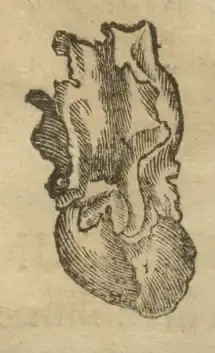
The acorn is somewhat round and protected by a prickly cupule; it has such a bitter taste that no animal except for swine will touch it. Now, sometimes the substance of this fruit, along with the matter of the cupule and the leaf, somehow becomes muddled as it comes together to produce the fruit, resulting in a monstrous acorn, such as the one shown in illustration XXX.