History of Monsters 593
—nth [1597], who, besides many monstrous parts described in their proper place, bore a pig’s tail on his rear, above the anus.
We have observed monstrous tails in animals even more frequently. Lycosthenes mentions a horse born in a Pomeranian village in the year 1554 with a horrific head, drooping ears, turned-out lips, a slanted neck, and a tangled mane, which had a high crest rising where the tail should be. Furthermore, there are reports of calves born with lamb tails, and conversely, lambs with calf tails. Likewise, a rooster with the tail of a quadruped was shown in the second chapter of this History. Again, according to Lycosthenes, a tailed toad was seen in a Thuringian village near the Werra. And a trustworthy man, a diligent investigator of natural things, reported that a frog with a notable tail was once seen.
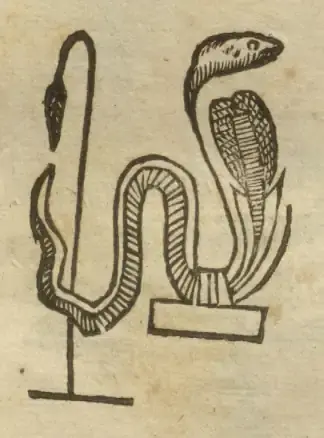
Finally, while all serpents are naturally equipped with long, rounded tails, it does happen that a monstrous serpent tail—specifically a compressed or flattened one—is seen. I remember seeing an illustration of a serpent (if indeed it is real) in the Bembine Table, if I am not mistaken. This serpent seems not to follow the nature of others at all, as it had a very wide body behind the neck, almost oval in shape, yet with a very compressed tail, as the reader can observe in Illustration I.
I. Serpent with a compressed tail.
So much for the malformation of tails; now we must consider their doubling and multiplication. Indeed, although calves, lambs, and dogs are rarely found with two tails, the multiplication of tails is frequently seen in another kind of animal: lizards. We have seen lizards with two, three, and even four tails, which the common people then quite foolishly proclaim to be lucky omens. Giambattista della Porta, in his *Natural Magic*, was of the opinion that these tails could arise from no other cause than double-yolked eggs. We present these monstrous lizards for the reader to see in Illustration II.
But among others, a four-tailed lizard given to us as a gift in the year 1596 was particularly remarkable; its longer tail produced three other small branches. For this reason, we concluded that this monstrous animal was born from an abundance of matter, especially since the other parts of its body were larger than normal.