# History of Monsters. 49
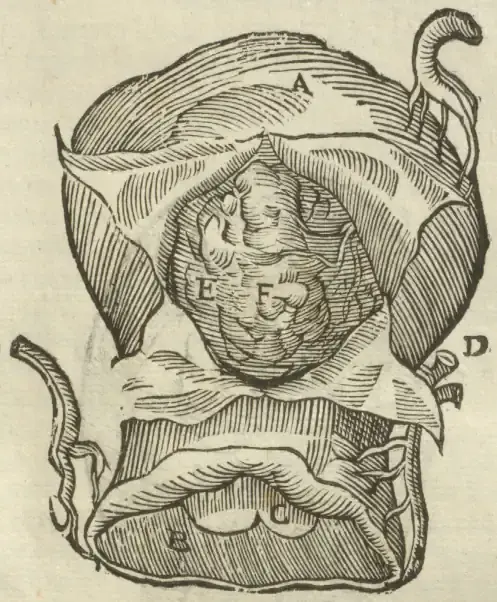
Illustration of the Embryo
**A.** The fundus of the uterus. **B.** The opened cervix of the uterus. **C.** The orifice of the uterus. **D.** Veins and arteries which form the cotyledons on the concave surface of the uterus. **E.** The allantoic membrane. **F.** The fetal tissue. **G.** Varicose vessels.
Once nature has elegantly constructed and integrated this work with all its limbs, she covers it with skin. Then, as Saint Augustine testifies, the God of nature and author of all things infuses it with a soul. For this reason, according to Augustine’s opinion, if anyone strikes a pregnant woman so that she miscarries, he should suffer the death penalty, provided that the infant has already achieved a perfect formation and distinction of its limbs; otherwise, he must pay a fine.
According to Galen, the fetus is bound within the womb just like fruit upon a tree. Indeed, just as fruit is extremely delicate when it first follows the flower and falls for the slightest reason, but as it grows it becomes more firmly attached to the tree and, once it reaches full maturity, falls of its own accord—so too is the infant bound to the uterus by fragile connections when it first develops from the seed. Because of this, a woman may miscarry for any minor cause; however, a little later, as the fetus becomes more secure, it clings more firmly, and when the time for birth arrives, it emerges into the light of its own accord, like perfectly ripened fruit.
It is, however, extremely difficult to know and understand the exact position of the infant in the womb with certainty, as the illustrious Paré observed various placements of the fetus in both living and deceased women.
At times he saw the infant with its feet raised upward, and at other times stretched downward. Indeed, he confesses to having seen a fetus, upon dissecting a mother immediately after she had expired, stretched out lengthwise with its face turned upward and its hands joined as if in prayer. For the most part, however, the fetus tends to take an orbicular shape—namely, with its head resting on its knees, both hands tucked under its cheeks, and its heels drawn up to the buttocks, as shown in the following figure