36 Ulisse Aldrovandi
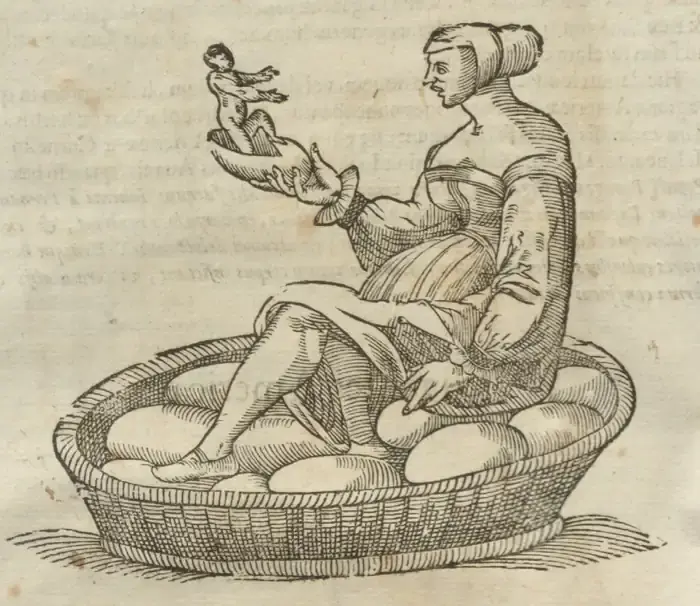
Nor shall we recount the Selenitide women who, contrary to the nature of others, lay eggs; from which the children grow to a giant stature, as Jean Tixier de Ravisi asserts, citing Lycosthenes.
Illustration of a Selenitide woman.
For the memory of giants is not absent from the pages of Sacred Scripture; indeed, we read in Genesis: "There were giants on the earth in those days." Elsewhere it is also recorded: "We saw certain monsters of the sons of Anak, of the giant race, compared to whom we seemed like locusts." Furthermore, was not Goliath a giant, whom David killed by striking him down with a sling?
Moreover, Rabbah (or Rabbath), the city of the sons of Ammon, was so named because of its great size. It eventually became the royal Philadelphia, the capital of the land of the Ammonites, where giants once lived until they were destroyed by the sons of Lot. This city was the seat of the King of the Ammonites, which is why it was later called Ammonitis. Og, the giant King of Bashan, conquered it, and his iron bed—nine cubits long and four cubits wide—was displayed there.
Eventually, David destroyed the city and slaughtered the people. Later, the city and the entire region were subjugated by Ptolemy Philadelphus, the King of Egypt, and it was renamed Philadelphia, a name it still retains today. In Christian times, it held a metropolitan bishop who presided over twelve other bishops.
To support this view, human bones of immense bulk found at various times testify that men of giant stature once lived. Sigebert relates that on the shore of Utica near Africa, a giant tooth was found so massive that, if it had been cut into the shape of our own teeth, it would undoubtedly have produced a hundred of them.
Pedro Simón is the authority for the claim that giants were discovered during Alvarez's expedition to the New World. He also reports that when a certain villa of the Society of Jesus was being built four leagues from Mexico City, giant bones were found among the building materials, including a molar tooth equal in size to a human hand clenched into a fist. The scale of such a find is evidenced by the teeth illustrated here as numbers 3 and 4.