History of Monsters. 427
tina [Strasbourg], a monstrous goose was discovered inside an egg. It possessed two heads and two tongues, yet only a single neck and a double vent for excrement.
Therefore, we present here two illustrations of the chicken chicks we have observed. The one labeled number VIII was born with twin heads, though it had only two wings and two feet. Its back was a grayish-white color, while its temples and neck were yellowish, its breast and belly white, and its shanks and feet a chestnut hue. The illustration placed under number IX shows a monstrous chick with a double beak. Nature perhaps intended to form a *dicephalon*—that is, a two-headed creature—but ultimately, the material for two heads was fused into one, forming a chick that is *dirrhynchos*, meaning it is complete with only a double beak.
Furthermore, if we turn our attention to the family of snakes, we will find that it also is not lacking in monsters of this kind. Although Aristotle stated that errors in the generation of snakes are rare—and consequently, that monsters are seldom born in this class of animal—this is because snakes have a very long womb or uterus, and the eggs descend one after another rather than in a mass, as happens with chickens. For this reason, it is rare to see twin fetuses in snake eggs, while they are frequent in those of hens. Nevertheless, it does not mean this never happens among snakes, as Aristotle himself mentions a two-headed snake. Indeed, Aelian reported that near the river Arcas, two-headed snakes sometimes roam, reaching four cubits in length, with white heads and the rest of the body black.
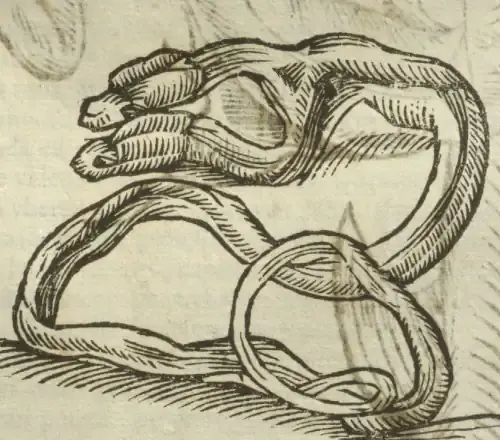
XI. Two-headed Snake.
Arnoldus also claims that a three-headed snake was once killed in the Pyrenees mountains. From this, some conclude that the seven-headed Hydra of Lerna might have once existed in the natural world, though we have demonstrated in its proper place that this is a fable. Likewise, Giambattista Porta observed a two-headed viper in Naples that moved both heads and extended triple-forked tongues.
Therefore, we should not be overcome with wonder; for today, even a two-headed snake, very carefully dried, was brought to the Illustrious Count Filippo Aldrovandi, a Senator of Bologna. It is preserved in the public Museum exactly as shown in this illustration.
Moreover, if we are permitted to diligently examine the family of aquatic creatures and search their hiding places, we will undoubtedly find far more monsters than in other classes of animals