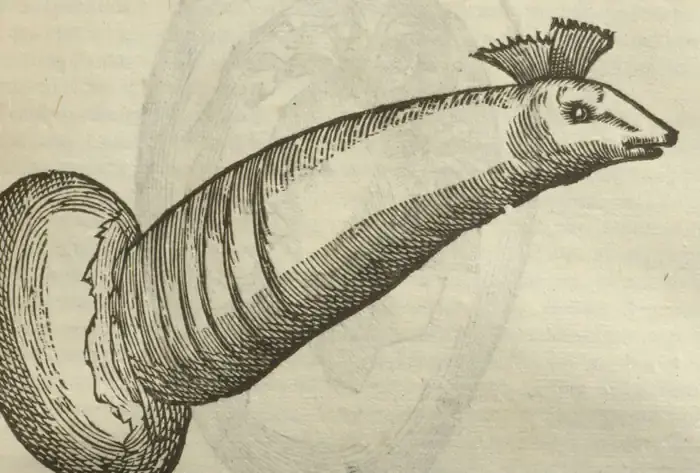
History of Monsters. 389
A monster in the shape of male genitals.
The most learned Licetus, in his *History of Monsters*, reports that he himself kept a hen at home that had five toes. After laying many eggs, she produced one tiny one that lacked a yolk; inside its white, a serpent-like worm was discovered. He quite rightly suspected that the egg's yolk had been transformed into this creature. Indeed, he cites the illustrious Fabrizio d'Acquapendente as a witness, who likewise found a fairly large worm inside an egg yolk while he was eating. We find this easy to believe, as last year we were shown a worm—somewhat resembling a fish—that had been found in a soft-boiled egg.
What is more, Ambroise Paré recounts a monster found in the very center and depths of an egg. It had a human face, but its head was bristling with serpents on all sides, and three more serpents sprouted from its chin like a beard. This occurred in Autun, in the home of a lawyer named Bancheron, while a maid was cracking several eggs to be cooked in butter. The white of this monstrous egg was eaten by a cat, which died as a result. Many people, attributing these reported monsters to divine causes, interpreted this as a portent of the heresies then creeping through that region.
Not much different from this was a goose egg found in France. When it was cracked open, a human head was seen; in place of hair and a beard, it had goose necks, each with its own beak and eyes, just as the illustration on the facing page shows. These monstrous eggs bring to mind the mythical head of Medusa, as well as Leda, who was said to have laid two goose eggs; from one, the ancients imagined Castor and Pollux emerged, and from the other, Helen and Clytemnestra.