History of Monsters. 387
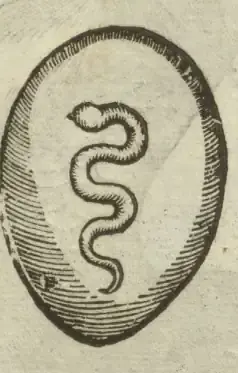
...by placing here the image of a chicken egg given to us as a gift by Petrus Vuettendellius, a German-Dutch Doctor of Philosophy and Medicine. It was discovered in Pisa on the twelfth of February in the year 1594, and the image of a serpent could be clearly seen on its shell. This learned man believed that the hen, through the power of her imagination, had produced this monstrous egg either because she had been frightened by a serpent, or because she had greedily devoured one—or at least desired to do so. This should not seem surprising, as various monstrous things are seen from time to time in eggs or are hatched from them, such as that monstrous rooster with a somewhat serpentine tail, the illustration of which is shown on the following page.
A chicken egg embossed with the image of a serpent.
This bird was seen alive several years ago in the court of the Most Serene Grand Duke of Tuscany, Francesco de' Medici. It was so horrific in appearance that it struck fear into those who looked at it. Its head was not topped with a fleshy comb, nor did it have fleshy wattles; instead, both were made of feathers that mimicked the military plumes typically used to adorn helmets. It had two feathers on its forehead—or rather upright quills—like horns. Likewise, it had two others on each side of its beak near the nostrils, and another on its neck. The color of its entire body was brownish, and the bases of the feathers were white; near the rump where the tail emerges, it had a round, whitish bump. The tail was fleshy, bluish, bare of hair, and twisted like a serpent, though there was a tuft at the very tip. Its legs looked as if they were clad in boots.
Similarly, from a chicken’s egg—or as others assert, from a "cock’s egg" (if indeed roosters can lay such eggs, a subject discussed in my *History of Serpents*)—a monster in the shape of male genitalia was hatched in a certain village named Emmen, near the noble Swiss town of Lucerne. It was marked by a single testicle and a head that was crested and somewhat dog-like. According to the records of Lycosthenes, this occurred in the year of our Lord 1488, just as the figure shows.