History of Monsters. 338. Ulysses Aldrovandi.
-ted demons who snatched away men with violence; thus, if anyone was vanished from human sight, they were said to have been torn apart by Harpies. Others established them as the daughters of Thaumas and Electra, while others believed them to be the offspring of Earth and Sea. For this reason, Servius called them "birds of the Sea"—and not without cause, as many of the ancients named the Harpies the daughters of Neptune, since they once regarded the Ocean as the father of almost all wonders. Virgil, however, speaks of them in this manner:
"No monster more grim than these, no fiercer plague or wrath of the gods ever rose from the Stygian waves. They have the faces of virgins but are birds; the filthiest discharge from their bellies, hooked hands, and faces always pale with hunger."
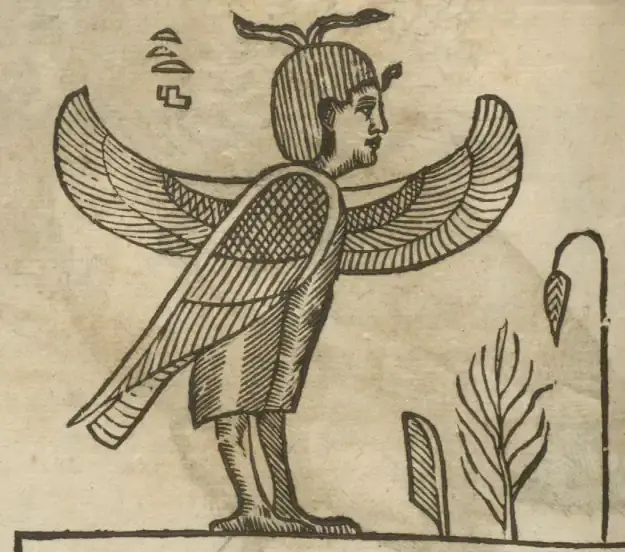
Regardless of these accounts, we consider them to be the monstrous trifles of poets. Now we shall turn to the first image of the plate, which shows the depiction of a bird, except for the face, which is human. The head is adorned with curly tresses, the feet are black, and certain scales cover parts of the wings. At first glance, one might conclude this image represents a siren, or rather, an Egyptian Harpy.
Let us now move to the second image, which likewise represents a mythical Harpy; it does indeed have a human face, while its other parts appear to belong to a bird. The third shows a woman's face with a vase at her feet, from which a plant emerges that seems to represent a palm.
Harpy, the second icon.
Harpyæ