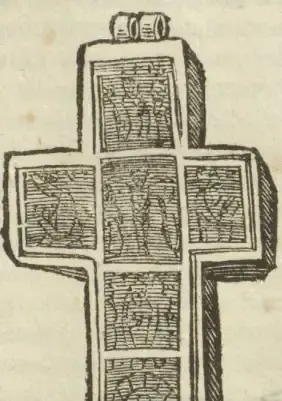
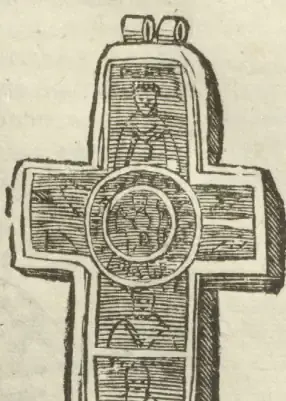
The wooden cross of the Muscovites.
The Lithuanians once worshipped fire, and indeed, they would seek various omens from it; furthermore, they held the Sun, in the form of an iron hammer, as their leader. In Prussia and Livonia, individual families kept a sacred hearth and home in the woods, where they would cremate the bodies of their deceased along with their horses, saddles, and more precious garments. The Poles are a prudent people and treat their guests with great kindness. In Hungary, when a legal case was uncertain and could not be resolved by other means, it was decided by the sword; the plaintiff and the defendant would fight before a judge, and the one who stepped outside the boundaries of the fighting circle was declared the loser.
The Bohemians believed it was pointless to perform funeral rites for deceased ancestors. The German magistrates conducted no business, whether public or private, unless they were armed. Today, the Germans are said to be capable of enduring any amount of labor, leading one poet to sing: "The Germans can endure all labors / but I wish they could endure thirst just as well."
The Saxons ate quite coarse food, and whatever was to be eaten during the week was gathered on Sunday. They feed their infants not with pap, but with more solid food that has first been lightly chewed in the nurse's mouth, believing that as the children grow, this makes them stronger. In many parts of Franconia, all the young women who attended dances throughout the year are rounded up by the young men on Ash Wednesday and dragged to a river or lake accompanied by a flute player. Johannes Bohemus believes this is done to expiate those who, contrary to the Church's commands, did not abstain from their frivolity on holy days.
In Swabia, they maintained a sacrificial ritual where all people of the same blood would gather in a forest at an appointed time and celebrate publicly by slaying a man. They held such reverence for this place that no one would enter it unless bound with chains. The Goths (or Getae) also used to drown the person chosen for sacrifice in a spring. But the Massagetae—the "heavy" Getae—would throw those killed by disease to be devoured by dogs, while those who died in battle were buried with the highest honors.
According to Procopius, the women of the Thalitae did not nourish their infants with milk. Instead, they would hang a newborn, wrapped in skin, from a tree and feed it repeatedly with the brains and marrow of wild beasts. Because they did not take to their beds after childbirth, the mothers would return to their usual hunts alongside the men. To these we add certain hunters from the Northern regions who, wearing Turkish-style caps and square wooden shoes, hunt wild boars with poles and roe deer with arrows.